| Symbol | Side | Layer | Size | Entry | Mark | SL | uPnL |
|---|
| Symbol | Side | Layer | Size | Limit Price | SL (on fill) | Status | Age |
|---|
| Time | Deal | Symbol | Type | Direction | Volume | Price | Notional | Fees | Net | Profit | Balance |
|---|
| Time | Account | Symbol | Action | Layer | Size | Status | Detail |
|---|
{{strategy.order.alert_message}}, Webhook URL = your preset URL from the generator. After that, every line below fires automatically when your strategy hits its condition.anchor groups one setup, layerN counts layers inside it. Sizing & leverage come from your webhook preset.close with no layer_id flattens the whole symbol on that account.sl_price is a number (no quotes). The bridge moves the stop on that layer.close / update_sl line above.
.P for MEXC perps, plain BTCUSDT on Bybit / Binance). You never type a suffix.Three steps, once — then your strategy trades itself through the hook you built above.
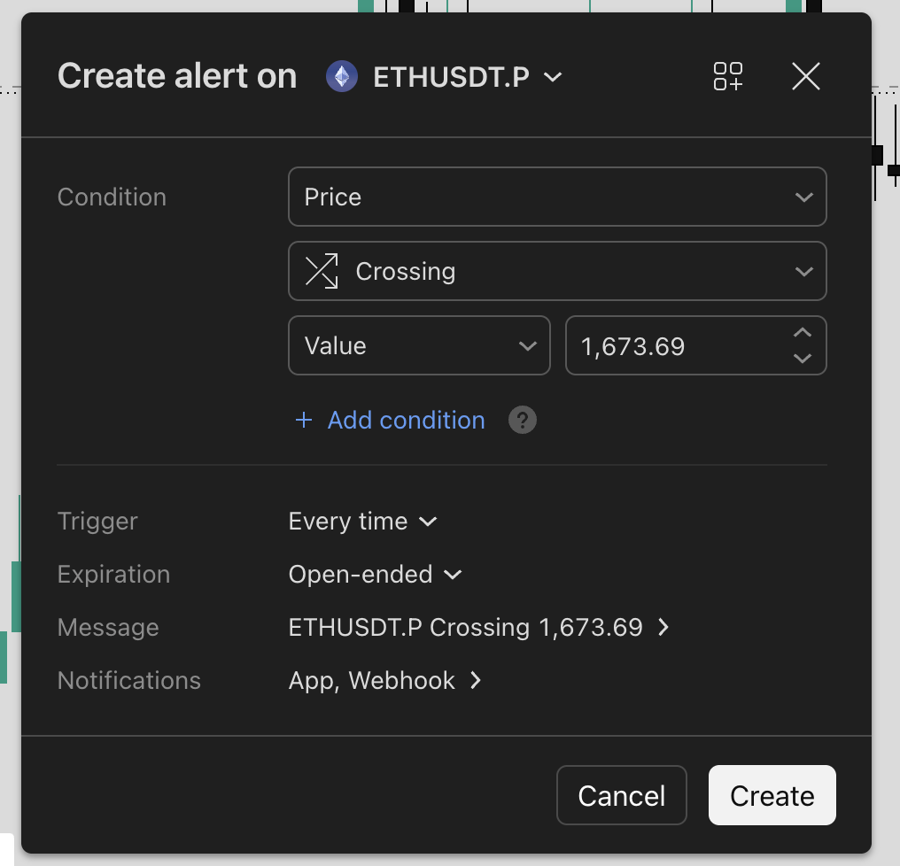
{{strategy.order.alert_message}}
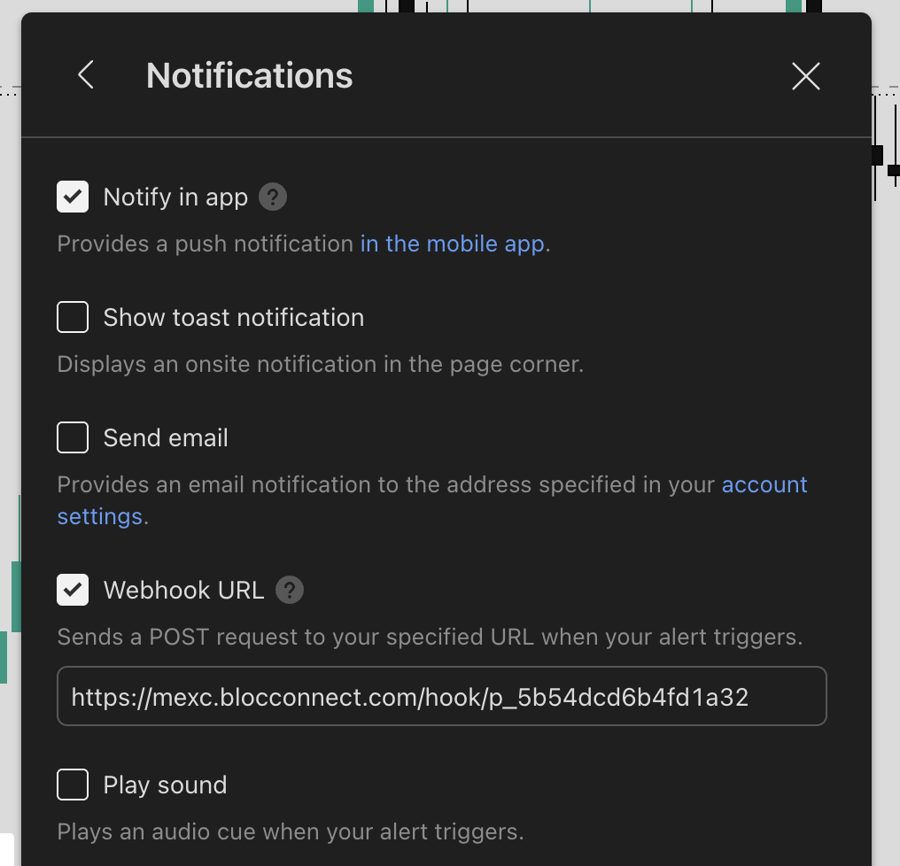
Name it, pick the account, set sizing — the webhook URL and the message box build themselves on the right. Paste those two into the alert above. (This is the live builder below; the picture just shows it filled in.)
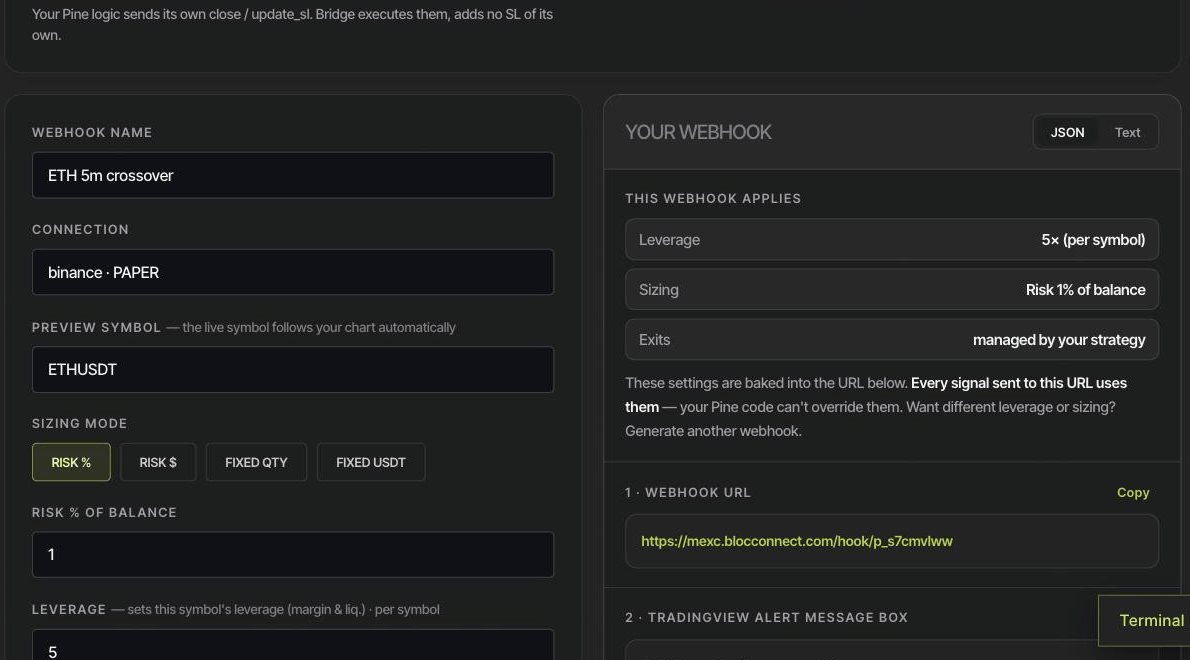
Embed the alert_message inside each strategy.entry(). Use a single-quoted Pine string so the JSON's double quotes don't clash. The layer id lives in the message — the bridge reads it, you don't type it into TradingView. Set the alert's message box to {{strategy.order.alert_message}} and it forwards whatever each order sent.
You don't set sizing here — you choose it per webhook in the Webhook Generator, and it's baked into that webhook's URL. This page is just a reference for what each mode does. Risk % is computed from each account’s own balance. Server-side ceilings live in Settings → Risk Guards.
Python forward testing, on live and on paper, belongs to The Strategist and The Desk. Your current plan does not include it.
SEE THE PLANS- The dashboard, entire
- One connected account, live or paper
- The terminal
- Paper trading with venue emulation
- Risk guards, enforced server-side
- Everything in The Operator
- Three connected accounts
- Python strategy forward-testing, live and paper
- Webhook automation, unmetered
- Everything in The Strategist
- A panel built for many accounts
- Seats for a team, separated and scoped
- Onboarding by a person, not a page
Warsh's first signal: the cuts are gone — and two cycles are bottoming.
The Fed held, but the dot plot flipped from a cut to a hike under a hawkish new Chair. A liquidity headwind meets a quiet structural bid, into the post-halving / midterm-year trough.
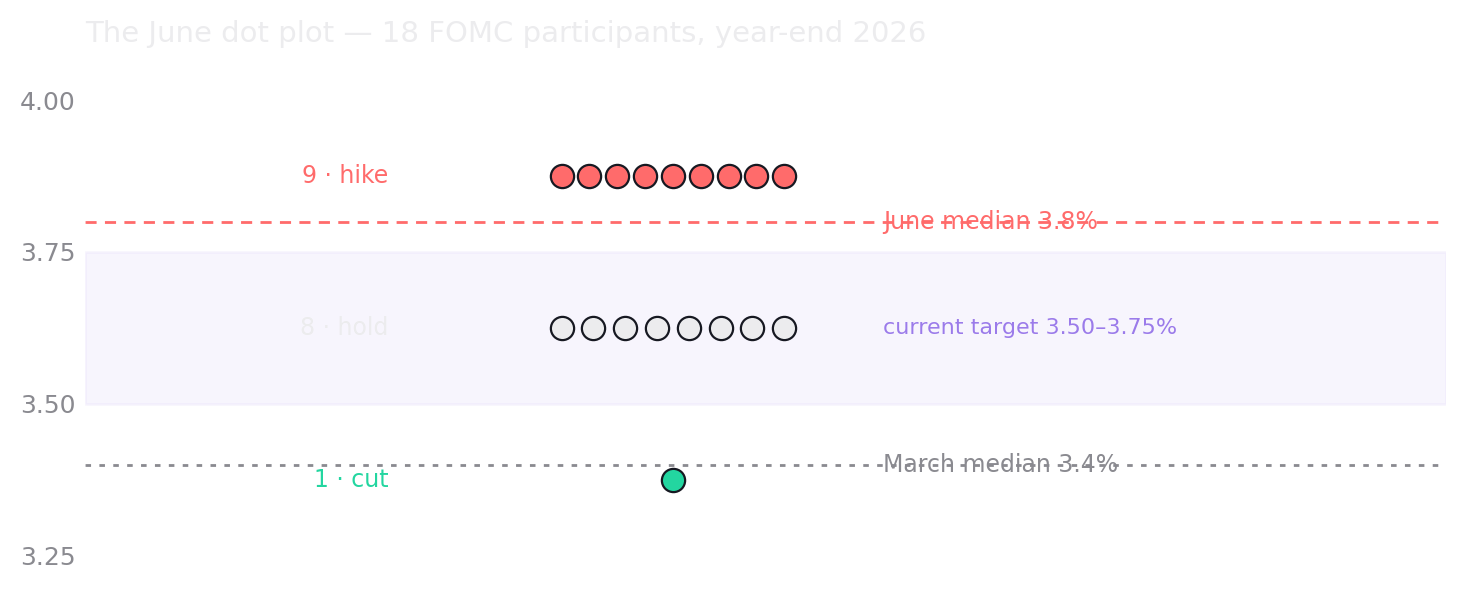
- The Fed held at 3.50–3.75%, but the June dots removed every 2026 cut and added a hike — median year-end up to 3.8% from 3.4%.
- It was Kevin Warsh's debut as Chair; he declined his own dot and is overhauling the Fed's guidance — a regime change.
- The trigger: re-accelerating inflation (May CPI 4.17%) against a resilient labour market.
- Risk repriced hawkish; crypto sold as the high-beta liquidity proxy.
- Two cycles meet here — Bitcoin's post-halving "off year" and the midterm trough — while long-term holders quietly absorb.
A hold that isn't a hold. The dots erased every cut and penciled in a hike; CME moved a hike into October at ~61%.
Warsh, a known hawk, declined his own dot and is rewriting the Fed's reaction function — a higher uncertainty premium.
Inflation re-accelerated and labour refused to crack.
May CPI 4.17% y/y; core ~2.9%; PPI surging on energy and tariffs.
Iran-conflict energy costs feed headline inflation the Fed can't ease away.
Q1 payrolls ran 2.5× the 2025 pace; wages outrun inflation.
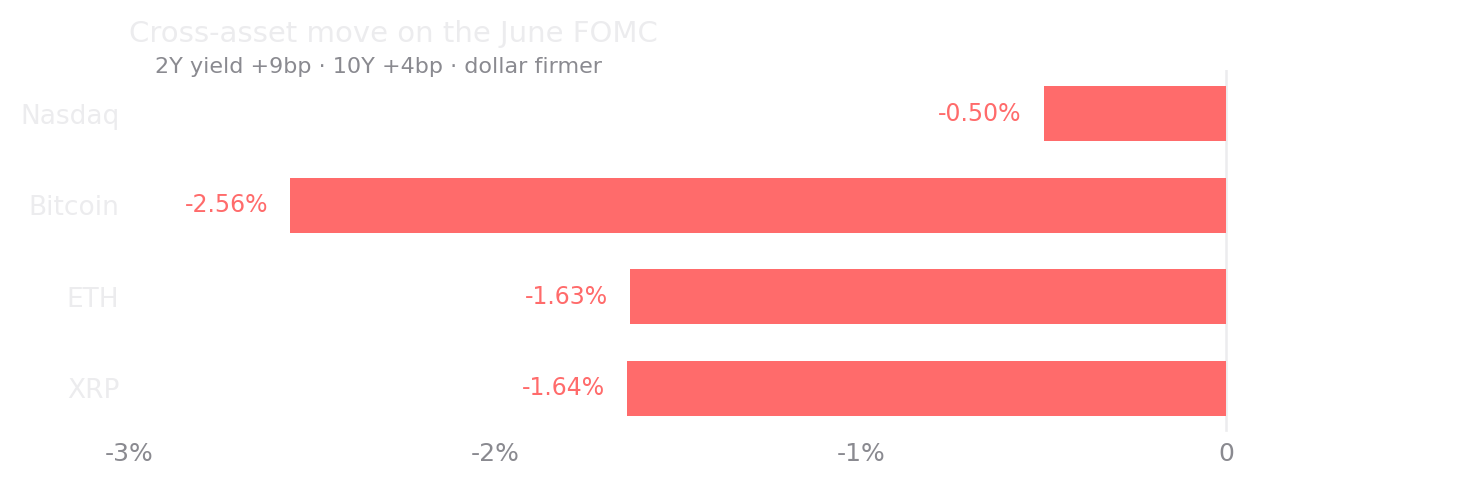
Textbook hawkish repricing — the front end led, the dollar firmed.
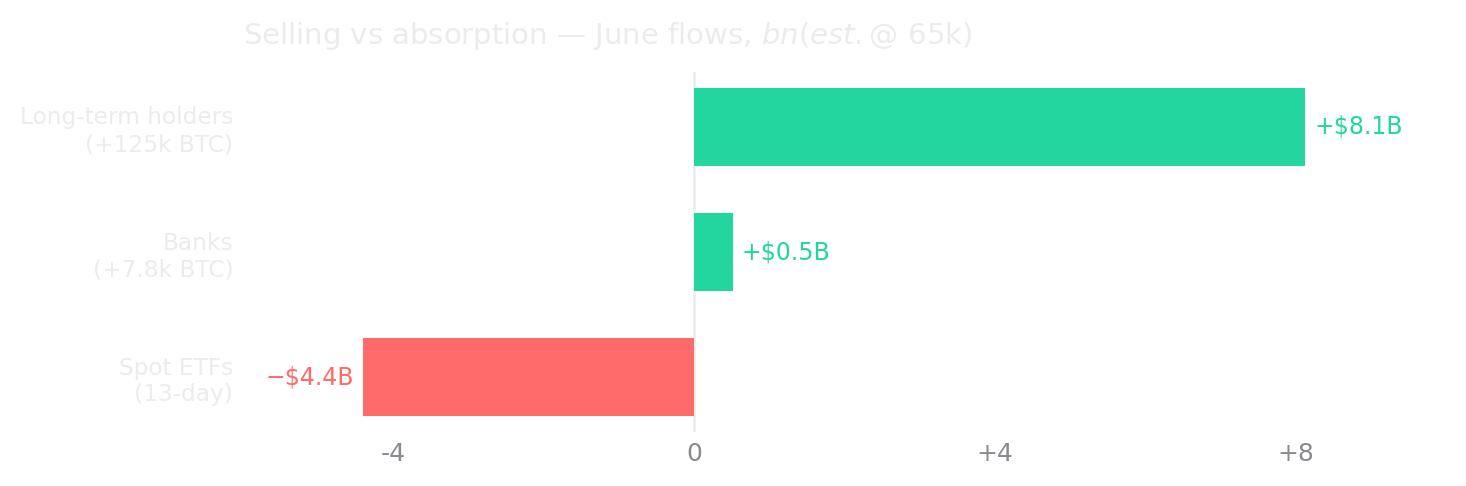
Tactical headwind, structural bid — flows leaving as coins move to stronger hands.
Bitcoin's four-year halving rhythm and the U.S. presidential cycle point at the same window — the soft one.
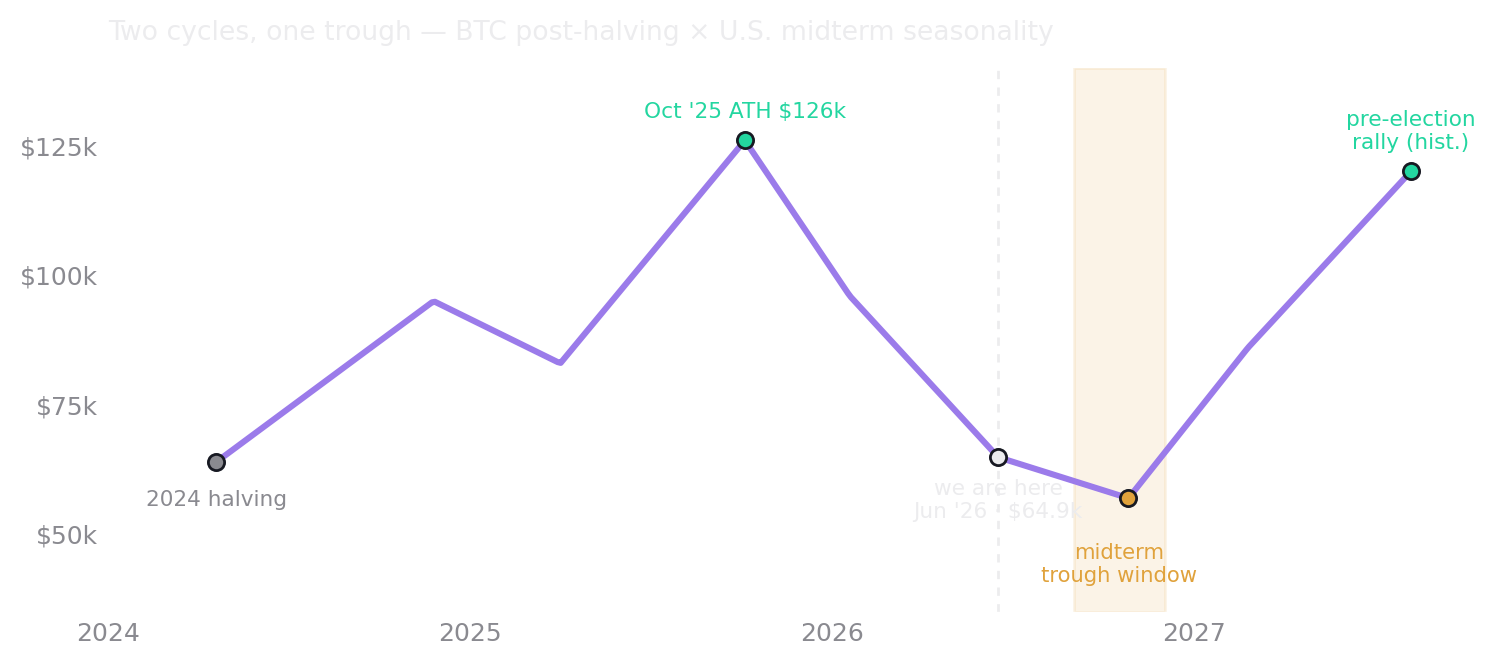
Post-halving digestion overlaps the midterm trough mid-to-late 2026 — accumulation is positioning for the turn.
Views split — bears $60–75k, bulls $150–170k. A base rate, not a guarantee.
A light week now, a heavy one next.
The Fed's preferred gauge. Hot validates the hike; soft is the first crack.
Financial-conditions read at 4pm ET.
~80% out-of-the-money; the biggest crypto-native catalyst.
A magnet — a weak one. Large expiries miss by 5–10%; macro overrides it.
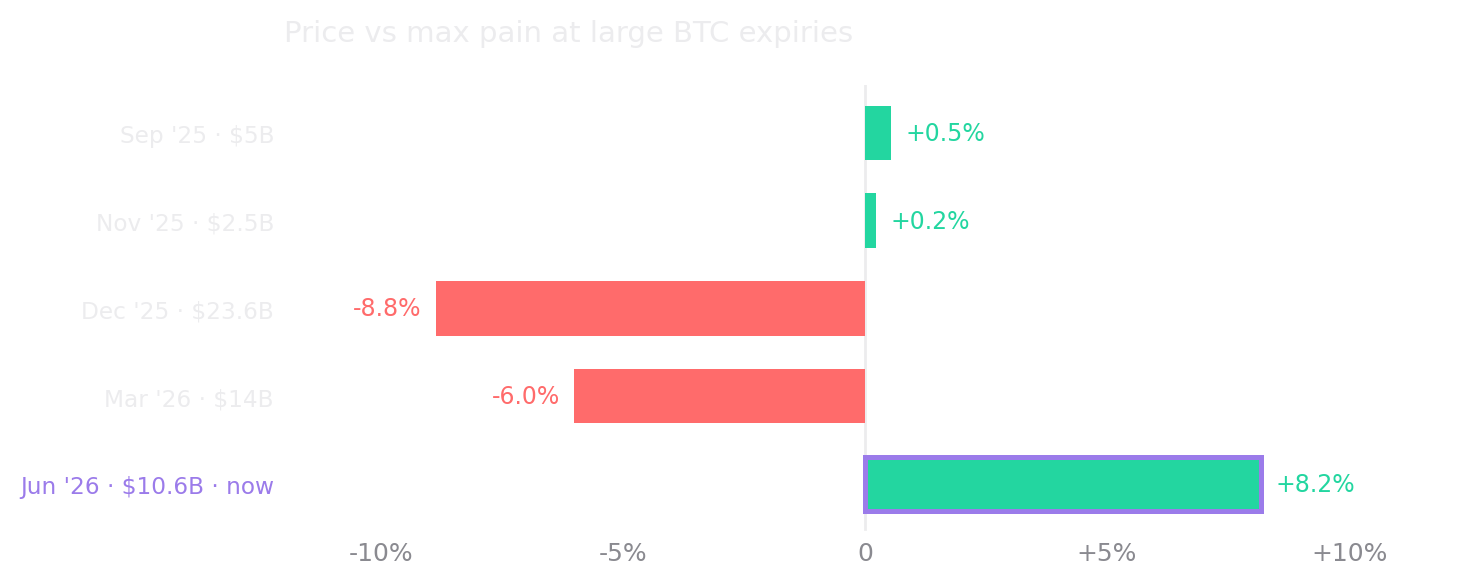
Defensive on macro, constructive on structure — expect range, not capitulation.
Hot PCE/CPI + an October hike. BTC loses $64.5k and tests the $57–60k cycle band.
Range and grind. ETF selling absorbed by long-term demand; $62–70k holds.
PCE cools, the hike is priced out, flows turn. The tightened float drives the snap-back.
Coiling above the line — the pattern that resolved up, hard, three times.
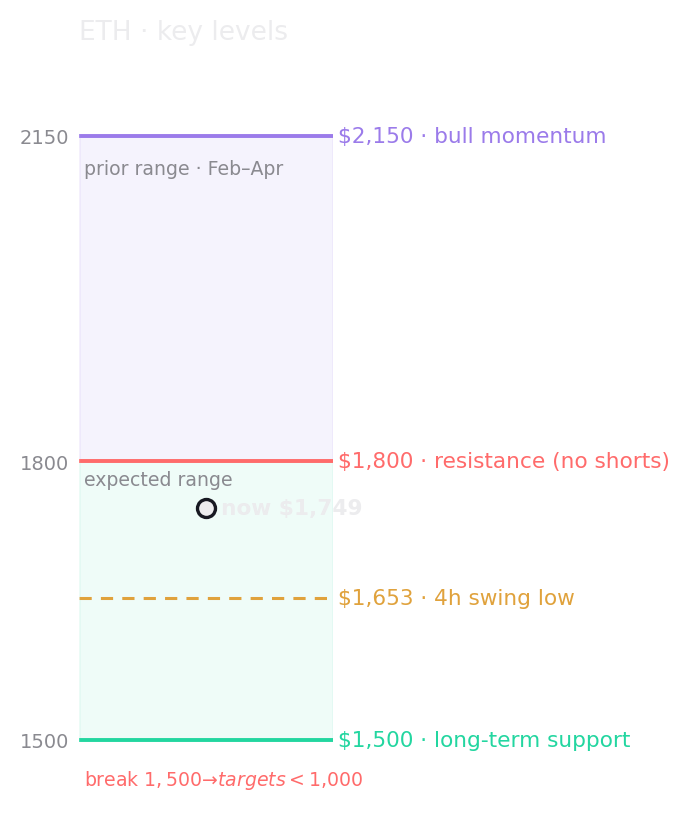
Holding $1,500; every consolidation below $1,800 broke out +150–170%. Buy a 3d/5d FVG below $1,800; short only below $1,500.
Liquidity taken, no-man's-land — but the 3-day structure is turning up.
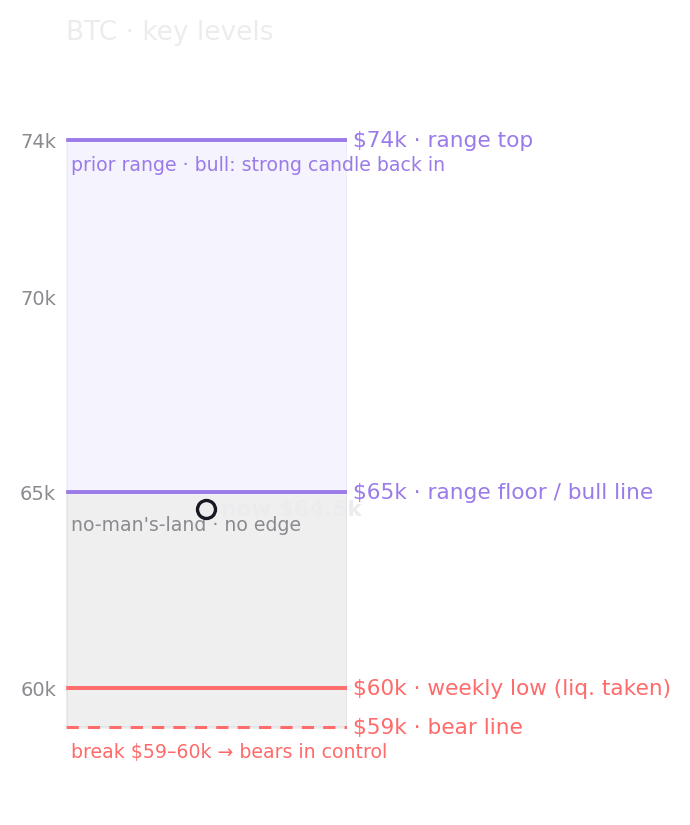
Swept the $60k low; $59–65k has no edge. Bulls: a strong candle into $65–74k. Bears: a break of $59–60k.
Price action draws the lines; fundamentals say when and why they break; the cycle says how long.
Your bull/bear lines ($65k / $59–60k) bracket Monday's PCE; $64.5k is the battle line; $60k max pain overlaps the bear trigger.
"Hold $1,500 → big breakout" is the post-halving / midterm setup; the >$2,150 break needs the same macro turn that frees BTC.
Your levels give the triggers, the calendar gives the timing, the cycle gives the horizon — and on this map, all three agree.